The sections are short and may be read in any order, like rooms. Each begins with a sentence borrowed from someone older and wiser. What follows is only a commentary.
The Indigo Plant
Blue is drawn from the indigo plant, and is bluer than the plant.
Xunzi wrote this to praise a student who surpasses the teacher. It can also be read as the description of a method. A colour is taken from the world. It is refined. What returns is more itself than what was taken.
The plant Xunzi names, 蓝, crossed the sea and became 藍, ai, the indigo of Japanese dyers. It is said that a British chemist, arriving in the Meiji years, saw it on the clothes and shop curtains of Tokyo and called it Japan Blue. So one plant was read in Chinese, grown in Japan and named in English. These pages are written from the same three places.
The passage goes on: Ice is made of water, and is colder than water. On an island where the Sea of Okhotsk arrives as ice each February, this needs no commentary.
The Five Colours
The five colours blind the eye.
The world offers more colour than anyone can see. Every surface asks to be looked at, and in the asking, nothing is.
Taking colour out of a photograph is therefore not a loss. It is a remedy. The black-and-white image is the world with its loudest voice lowered, so that the quieter ones can be heard: the weight of a wall, the direction of light, the distance between two things.
Know the White
Know the white, keep to the black, and be a pattern for the world.
Read literally, this is advice for photographers. A picture made only of light and its absence is not missing anything. It is keeping to something.
Japanese ink painters call the untouched paper yohaku, 余白, the white that remains. It is not background. It is the part of the picture allowed to breathe. The greys in these photographs are meant in the same way: not colour withheld, but room left open.
What Flows
You cannot step twice into the same river.
Every photograph is a proof of this. The light on that wall, the car at that corner, the puddle before it dried: none of them will be found again.
The tea masters of Japan kept the same thought in four characters, ichigo ichie, 一期一会: one time, one meeting. Each frame here is a single meeting, and it is over.
What Does Not
What is, is one, and does not move.
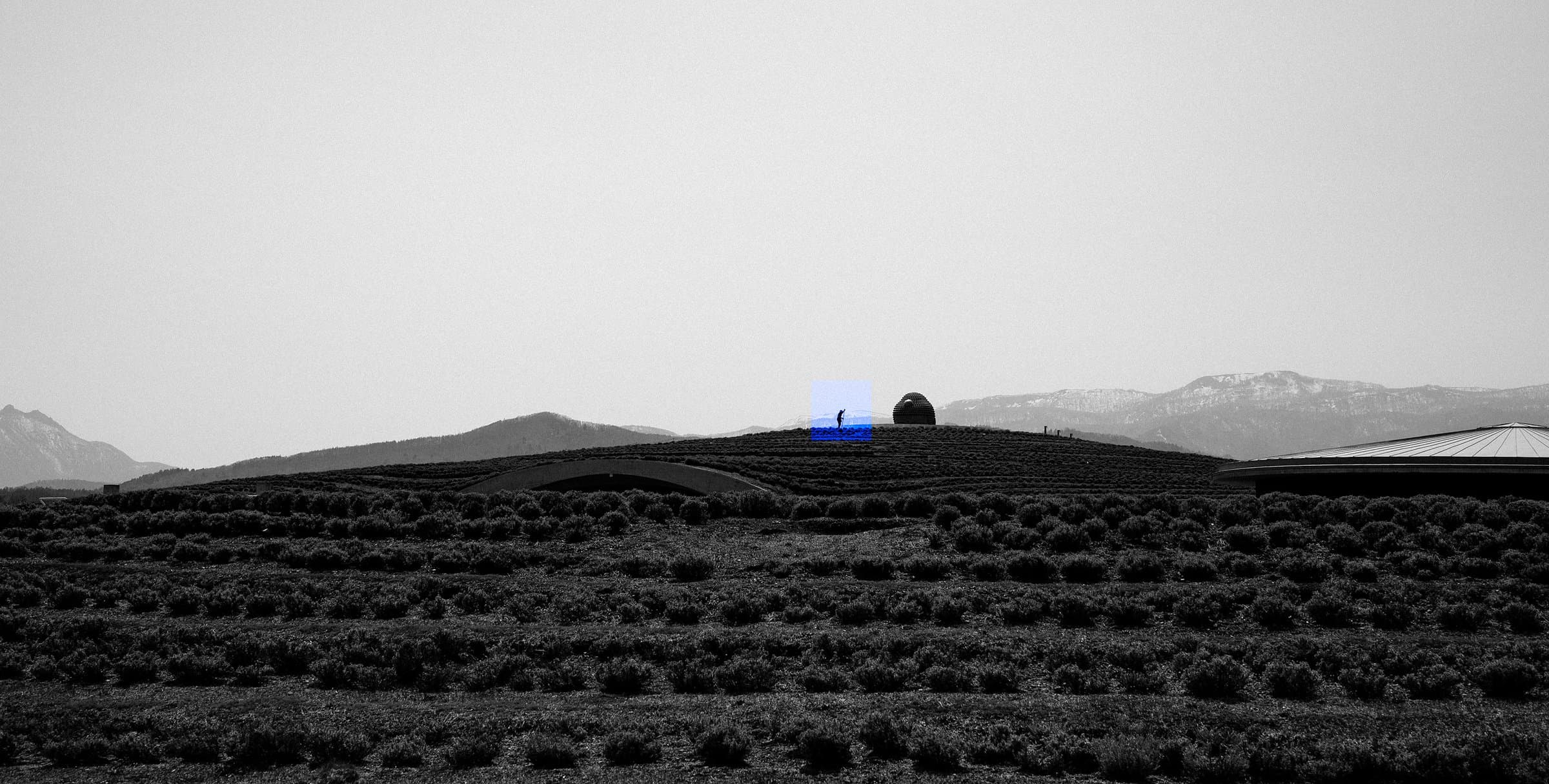
Against the river of photographs, one thing is held still. It is a blue, and it is defined not by an eye but by a number: 0, 80, 224, written #0050E0.
It is the same in a winter field and on a city street, in the first photograph and the last. It was not seen anywhere. It was decided.
Plotinus asked how a single colour can be beautiful, since it has no parts to stand in proportion. His answer was that its beauty is not arrangement but unity. A colour can be beautiful simply by being one.
The One and the Many
There is one substance, and it is expressed in infinitely many ways.
The oldest question in philosophy asks how the One relates to the Many: how a world that never holds still can share in anything that does.
Spinoza's answer gives this work its shape. The blue is one. Its appearances are many. It may be small or vast, single or repeated, obedient to the photograph or in quarrel with it.
None of these is an exception, and none needs defending. Each is the one blue, appearing otherwise.
Where Colour Lives
Tastes, odours and colours reside only in the consciousness. Take away the living creature, and they are annihilated.
Locke later called these the secondary qualities. Shape, size and number belong to the thing. Colour belongs to the one who looks at it.
If this is so, a black-and-white photograph shows the world as those philosophers imagined it without us: extension, surface, light. Nobody is in it yet.
Then one colour returns, and with it, a witness. The blue is the trace of a perceiver. It marks the place where someone was standing.
Ao
青 ao: blue; also green; also young, unripe, new.
In Japanese one word, ao, covers both blue and green. A traffic light turns ao when it turns green. Young leaves in May are ao.
In one of the first photographs here, a blue car waits outside a Zen temple whose copper roof has weathered to green. In English these are two colours. In Japanese they are one word.
#0050E0 is a narrow blue, cut from that wide one. It brings a precision into a language that had preferred not to choose. It is offered as a translation, not a correction.
Form Is Emptiness
色即是空,空即是色
Form is emptiness; emptiness is form.
In the sutra, 色 means form: matter, all that appears. In everyday Chinese and Japanese, the same character means colour.
The sutra does not say that colour is emptiness. We know this. But in photographs from which colour has been emptied, the second reading is hard to unsee. We leave it standing, as a pun the temple might forgive.
The Island
Winter in Hokkaido is a kind of One. Snow lays a single surface over field, road and roof, and the island becomes a black-and-white photograph without anyone's help.
Summer is the Many: lavender, potato flowers, forests in forty greens that Japanese would call ao.
The island moves between the two every year. The work only follows it.
The Rule
There is one rule.
The blue is always #0050E0.
Nothing else is fixed. Not its shape or its size. Not how often it appears, or whether it rests on something that was truly blue or arrives from nowhere. Not whether it agrees with the photograph.
This book does not list the forms the blue may take. They are found by making them. The photographs, not these pages, will say what they are.
For further reading
For the visitor who wishes to go on, in the order the rooms were entered:
- Xunzi, Encouraging Learning (劝学)
- Laozi, Daodejing, chapters 12 and 28
- Heraclitus and Parmenides, the fragments
- Plotinus, Enneads I.6, On Beauty
- Spinoza, Ethics (1677)
- Galileo, The Assayer (1623); John Locke, An Essay Concerning Human Understanding (1690)
- The Heart Sutra
And one story. In Alastair Reynolds's Zima Blue, an artist's work grows until it covers the walls of galaxies, while at its centre one blue stays the same. In the end Zima follows his blue back to where he began.
Zima's blue looks back. This one looks out.
- Editor
- Xiaolong Li
- Photographs
- Xiaolong Li
- Blue
- #0050E0
Read in Chinese, made in Japan, written in English. Hokkaido, autumn 2026.